 India
 World
 Entertainment
 Sports
 Chhattisgarh
 Haryana
 Delhi
 Religious
 Business
 Tech & Auto
 Education
 Health
 Andhra Pradesh
 Telangana
 Sikkim
 Odisha
 Jharkhand
 Assam
 Nagaland
The world's most unexpected event happened in the Pacific Ocean
When the clue was found, scientists were surprised
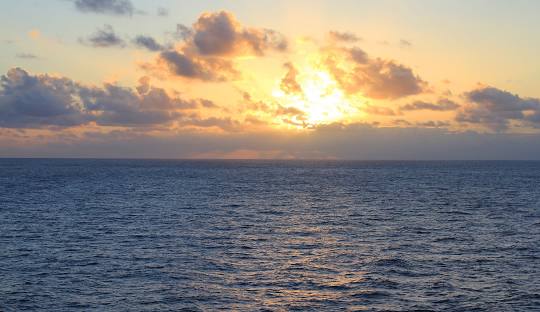
Sydney, scientists have found the clue to the world's most unexpected event in the Pacific Ocean. Everyone is surprised to know this. Scientists doing research on this incident said that something extraordinary must have happened on Earth 10 million years ago. Research done on rock samples taken from the bottom of the Pacific Ocean has revealed a strange increase in the radioactive chemical element 'Beryllium-10' during that time.
This research published in 'Nature Communications' has opened new ways for geologists to know the date of past events from samples obtained from the depths of the oceans. But the reason for the anomaly in Beryllium-10 is not yet known. Could this be due to major changes in global ocean currents, the end of a star, or the collision of two or more stars?
Researcher told what he saw with his eyes
A scientist said that rocks moving at extremely slow speeds in the depths of the sea I am looking for stardust (cosmic dust particles) on Earth. Earlier, I have sifted the ice in Antarctica. This time, I have searched in the depths of the sea. At a depth of about 5,000 meters, the abyssal region of the Pacific Ocean has never seen light, yet something keeps growing there. The rocks present under the metallic water, 'ferromanganese crust', develop by freezing slowly and over a very long period of time, combined with minerals dissolved in the water. These grow only a few millimeters in a million years. ('Stalactites' and 'stalagmites' in caves grow in a similar way, but thousands of times faster.) This process makes 'ferromanganese' crusts (layers) an ideal place to 'capture' stardust for millions of years.
Ferromanganese crust was found in the central Pacific in 1976
The age of these layers can be determined by radiometric dating using the radioactive chemical element beryllium-10. This chemical element is constantly produced in the upper atmosphere when highly energetic cosmic rays collide with air molecules. These collisions break up the main components of our atmosphere – nitrogen and oxygen – into small pieces. Both stardust and beryllium-10 eventually find their way into Earth's oceans where they become part of the growing 'ferromanganese crust'. One of the largest ferromanganese crusts was recovered from the central Pacific in 1976.
What scientists found
The results showed that the layer had grown only 3.5 centimeters in the last ten million years and it was more than two lakh years old. Radioactive decay occurs after a very complex process. This means that something must have introduced additional beryllium-10 into the layer at that time. Skepticism is important in the world of science. Chemical preparations were made and measurements were taken multiple times to avoid errors. After analysing different layers from locations about 3,000 kilometres apart, the result was that about 10 million years ago there was a strange increase in a radioactive chemical element called beryllium-10 in the Pacific Ocean.
Why did this happen 10 million years ago
Last year, an international study revealed that waves called the ‘Antarctic Circumpolar Current’ intensified about 12 million years ago, influencing the current shape of the Antarctic Ocean. Could this mark the beginning of modern global ocean circulation in the Pacific linked to beryllium-10? If ocean currents were responsible, beryllium-10 would be unevenly distributed on Earth and some samples would also show a deficiency of beryllium-10. New samples from all major oceans and both hemispheres may help us answer this question.